How much gravel for a shed base
For a pad 4 in deep, a foot past the shed on every side, with 10% extra because the stone settles when you tamp it. The amount is rounded up to the next tenth of a cubic yard, the way most yards sell it. The shed foundation calculator works out any other size or depth.
| Shed | Pad size | Stone to order | Weight | Or 50 lb bags | Plans |
|---|---|---|---|---|---|
| 6x8 | 8 x 10 ft | 1.1 yd³ | 1.5 tons | 59 | Gable, lean-to |
| 8x8 | 10 x 10 ft | 1.4 yd³ | 1.8 tons | 74 | Gable |
| 8x10 | 10 x 12 ft | 1.7 yd³ | 2.2 tons | 88 | Gable, lean-to |
| 8x12 | 10 x 14 ft | 2 yd³ | 2.6 tons | 103 | Gable, lean-to |
| 8x16 | 10 x 18 ft | 2.5 yd³ | 3.3 tons | 132 | Gable |
| 10x10 | 12 x 12 ft | 2 yd³ | 2.6 tons | 106 | Gable |
| 10x12 | 12 x 14 ft | 2.3 yd³ | 3.1 tons | 124 | Gable |
| 10x14 | 12 x 16 ft | 2.7 yd³ | 3.5 tons | 141 | Gable |
| 10x16 | 12 x 18 ft | 3 yd³ | 4.0 tons | 159 | Gable |
| 12x12 | 14 x 14 ft | 2.7 yd³ | 3.6 tons | 144 | Gable |
| 12x16 | 14 x 18 ft | 3.5 yd³ | 4.6 tons | 185 | Gable |
The lean-to sheds are named depth first, so an 8x10 lean-to stands on the same 10 x 12 ft pad as an 8x10 gable shed. Even the 8x10 pad is 88 bags, so have the stone delivered in bulk. Ask the yard whether it sells by the ton or the yard and what its smallest load is.
Which gravel to use
- 3/4 in crushed stone, often sold as #57 stone or clean stone. Its sharp edges lock together when you tamp it, and with no dust in it, water drains straight through. This is what our plans use.
- Crusher run (also called dense grade or road base) is crushed stone mixed with stone dust. It packs almost as hard as concrete and makes a very flat surface, but it drains more slowly. Use it on ground that drains well, or as the bottom layer with clean stone on top.
- Pea gravel is round, so it rolls under load and never firms up. Leave it for paths.
How deep should the pad be?
4 in of compacted stone is the usual depth for a storage shed, and it is what the table assumes. On soft clay or ground that stays wet, dig deeper and lay 6 in. For a 10x12 that is 3.5 cubic yards instead of 2.3 cubic yards. The skids spread the shed's weight along the whole length of the pad, so more depth does little on firm, well-drained ground.
What a gravel shed pad costs
The stone is the main cost, and its price varies a lot by region. In the GoodGravel Gravel Price Index for November 2026, the middle half of 200 yards across the US charged $31 to $70 a cubic yard for crushed stone, with $49 the median. At most yards, then, a 10x12 pad's stone costs $71 to $161. The table uses the median. Delivery is extra and depends on the distance, so ask for it with the quote.
| Shed | Stone at $49/yd³ | Landscape fabric | Pad | Timber frame | Pad with frame |
|---|---|---|---|---|---|
| 6x8 | $54 | $17 | $71 | $124 | $195 |
| 8x8 | $69 | $17 | $86 | $149 | $235 |
| 8x10 | $83 | $17 | $100 | $158 | $259 |
| 8x12 | $98 | $17 | $115 | $180 | $295 |
| 8x16 | $123 | $17 | $139 | $199 | $338 |
| 10x10 | $98 | $17 | $115 | $168 | $283 |
| 10x12 | $113 | $17 | $130 | $189 | $319 |
| 10x14 | $132 | $17 | $149 | $196 | $345 |
| 10x16 | $147 | $34 | $181 | $208 | $389 |
| 12x12 | $132 | $17 | $149 | $211 | $360 |
| 12x16 | $172 | $34 | $205 | $230 | $435 |
The fabric is one 3 x 100 ft roll, laid in strips that overlap by a foot. The 10x16 and 12x16 pads need two. The frame is 4x4 ground-contact timbers with 1/2 in rebar stakes; for a 10x12 that is 2 at 14 ft, 2 at 12 ft, and 18 stakes. Timbers, fabric and rebar are the regular shelf prices at Sutherlands in Harrisonville, Missouri on November 11, 2026 (the rebar on November 22, 2026). A plate compactor is a day's rental if you'd rather not tamp by hand.
For comparison, a 4 in concrete slab the size of a 10x12 shed takes 74 bags of 80 lb concrete, plus forms and a gravel base of its own. The shed foundation guide compares the pad with a slab, blocks and piers, and the shed cost guide prices the rest of the shed.
How to build a gravel pad for a shed, step by step
Tools: tape measure, stakes and string, a flat spade, a rake, a hand tamper or a rented plate compactor, a 4 ft level and a long straight board, a wheelbarrow and a utility knife. For a frame, add a saw for the timbers, a drill with a 1/2 in bit and a sledgehammer.
- Call 811 a few days before you dig, so buried lines get marked. It's free.
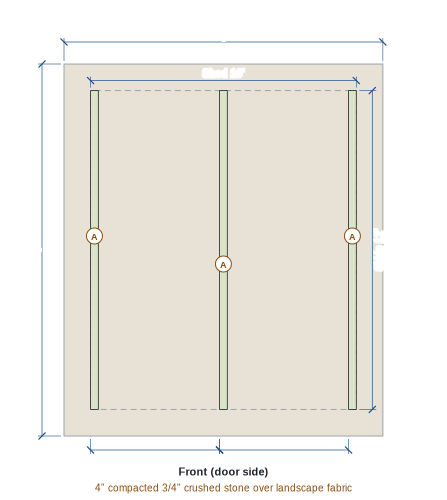
- Mark out the pad. Drive a stake at each corner and run string between them. For a 10x12 shed the pad is 12 x 14 ft. Measure both diagonals and move the stakes until they match, which makes the corners square; on this pad each is 18' 5-1/4".
- Strip and dig. Take off the grass and topsoil and dig about 4 in down, to firm soil. On a slope, dig the high side down rather than building the low side up, because fill settles. Check the bottom with the level on the straight board.
- Tamp the soil until your boots no longer leave prints.
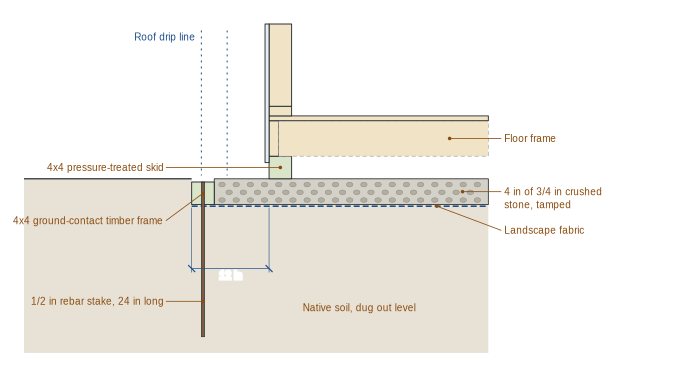
- Set the frame (optional). Cut the timbers so the long ones run the full length of the pad and the short ones fit between them. Level them on the dug soil, drill 1/2 in holes, and drive a 24 in rebar stake near each end of every timber and at least every 4 ft along it. A frame keeps the edges crisp and the stone where it belongs; without one, slope the stone down at the edges.
- Lay landscape fabric across the bottom in strips, overlapping each joint by about a foot, and up the inside of the frame. It stops the stone sinking into the soil and weeds coming up through it.
- Spread the stone in two layers of about 2 in, tamping each one hard. Thin layers compact much better than one thick one.
- Level the top. Drag the straight board across the pad, add stone to the low spots and tamp again, until the level shows no more than about 1/4 in of difference anywhere.
- Set the skids. A 10x12 shed sits on 3 pressure-treated 4x4 skids running its length. Lay them on the stone, level each one and level them with each other, then build the floor frame on top. In windy areas, anchor the skids to the ground at the corners.
Building on a slope
A pad takes up a gentle slope when you dig the high side down to the level of the low side. If the ground falls more than a few inches across the pad, a second row of timbers on the low side holds the extra stone. On steeper ground, concrete blocks or posts on piers are less digging; the foundation guide covers both.
Quick answers
How much gravel do I need for a 10x12 shed?
2.3 cubic yards of 3/4 in crushed stone, about 3.1 tons, for a 12 x 14 ft pad 4 in deep. A 12x16 shed takes 3.5 cubic yards, about 4.6 tons.
How thick should a gravel pad for a shed be?
4 in of compacted crushed stone for most storage sheds, and 6 in on soft or wet ground.
How much does a gravel pad for a shed cost?
For a 10x12 shed, about $130 for the stone and fabric, or $319 with a staked timber frame, before delivery. The stone alone is $71 to $161 at most yards.
Does a gravel shed pad need a frame?
No. A frame holds the edges and keeps the stone from spreading, and it makes leveling easier, but many pads just slope off at the edges. Add $189 for one around a 10x12 pad.
Is pea gravel or crushed stone better under a shed?
Crushed stone. Its angular pieces lock together when tamped, while pea gravel stays loose and shifts.
Does the shed sit right on the gravel?
The skids do. The floor frame sits on pressure-treated skids laid on the stone, which keeps the joists off the ground and lets air under the floor. Skids also make the shed possible to move later.